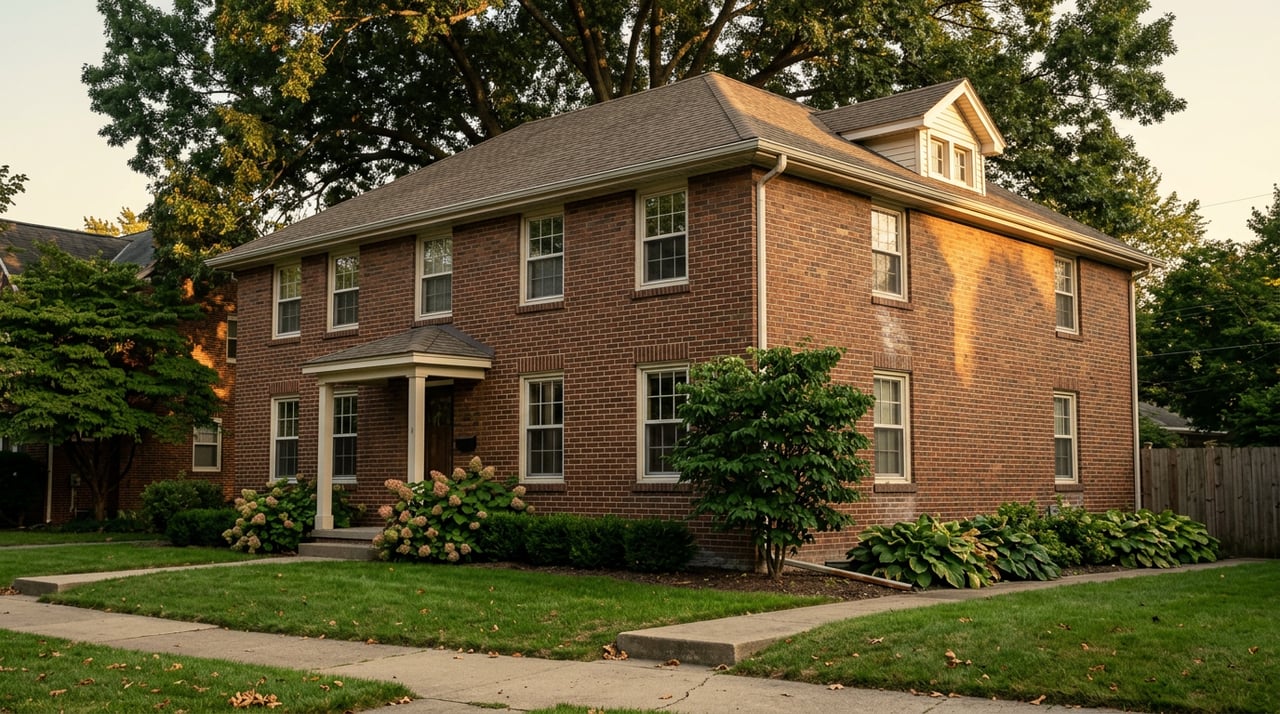
Walk down Park Avenue in Chapin Park on a Sunday afternoon and you will see the kind of houses that make people pull over. Gothic gables, wraparound porches, a hundred and some years of brick and trim that nobody builds anymore. Then you check how long the one with the "For Sale" sign has actually been sitting there, and the number doesn't match the house. Six months. Seven. In a city where homes are moving in three weeks, that gap is the story.
South Bend's overall market has been fast this year. Homes sold in a median of 22 days in the three months ending May 2026, down from 28 days over the same stretch a year earlier, and sale prices climbed 11.4 percent year over year to a median of $184,000. That is a market with more buyers than patience. But drop into Chapin Park specifically, and listing data compiled this summer shows an average of 221 days on market and a price per square foot around $126, well under the citywide figure of $133. The houses are not less desirable. Something else is setting the pace.
The clock buyers don't see on the listing
That something is the Certificate of Appropriateness, or COA, and it governs any exterior work on a property inside one of South Bend's nine locally designated historic districts: Chapin Park, East Wayne Street, Edgewater Place, Lincolnway East, North Saint Joseph Street, River Bend, Riverside Drive, Taylor's Field, and West North Shore Drive, the first of the group, designated back in 1978. If a home sits inside one of these boundaries, a homeowner or seller can't just call a contractor for a new roof, replacement windows, siding, a fence, a deck, a porch rebuild, tree removal, a garage, or even concrete work. Every one of those projects needs a COA from the Historic Preservation Commission of South Bend and St. Joseph County before a building permit gets pulled.
That alone wouldn't slow a sale down much if the approval process moved at the speed of a hardware store trip. It doesn't always. The commission runs on a two-speed system. Smaller jobs and like-for-like replacements, a roof that gets redone in the same material, a window swapped for the same style, can often be approved by staff in 24 to 48 hours. But anything involving a change in material or a visible change in appearance has to go in front of the full commission, and the commission meets once a month, on the third Monday, with applications due two full weeks before that meeting.
Here is where the timeline actually bites. The July 2026 meeting was cancelled. The next one is scheduled for August 17. A seller who wanted new siding done before listing photos, and whose project needed full commission review rather than a staff-level sign-off, effectively lost a month and a half of runway they didn't know they'd lost. In a citywide market where days on market are shrinking, that's the kind of delay that turns a competitive listing into one that opens the season behind everyone else.
Two different lists, and they don't always match
Part of the confusion buyers run into is that "historic" in South Bend can mean two different things, governed by two different bodies, and a house can belong to one, both, or neither.
| Designation type | Governing authority | Examples in South Bend |
|---|---|---|
| Local Historic District | City/County Historic Preservation Commission, requires a COA for exterior work | Chapin Park, East Wayne Street, Edgewater Place, Lincolnway East, North Saint Joseph Street, River Bend, Riverside Drive, Taylor's Field, West North Shore Drive |
| National Register District | Federal designation via the National Park Service, honorary unless paired with local designation | West Washington, Chapin Park, East Washington, Howard Park, St. Casimir's Parish, South Michigan Street, Muessel-Drewry Brewery |
Notice that Chapin Park appears on both lists. West Washington appears only on the national side, meaning a house there carries the National Register name and any tax-credit eligibility that comes with it, but it is not automatically subject to the COA requirement the way a Chapin Park or Riverside Drive home is. A buyer touring both neighborhoods and hearing "historic" applied to each could reasonably assume the rules are identical. They are not, and the difference shows up the first time either owner wants to touch the exterior.
A door that might be opening for renovation costs
There's a second thread worth watching if you're weighing a fixer-upper in one of these districts. In late 2024, the Historic Preservation Commission moved to seek National Register of Historic Places status for the Lincolnway East and North St. Joseph-Riverbend districts, specifically because that designation would make exterior rehab work eligible for federal grants and tax credits. That kind of application moves through state review before a final call from the U.S. Department of the Interior, so it's a multi-year process rather than a quick vote. But for anyone considering a larger renovation project on an older home in that part of the city, it's a genuine reason to ask where that National Register push currently stands before assuming a rehab budget has to be paid entirely out of pocket.
What this actually means if you're buying or selling here
If you're selling a home in one of these nine districts, the practical move is to find out early whether your pre-listing project needs staff sign-off or a full commission hearing, because that distinction is the difference between a two-day wait and a six-week one depending on the calendar. Building in that lead time before you set a listing date protects you from watching a hot spring market pass by while you're waiting on a meeting date.
If you're buying, the lesson cuts the other way. A house that's been sitting for months in Chapin Park or Riverside Drive isn't necessarily a red flag on the property itself. It may simply mean the seller hit the commission calendar at the wrong time, or that a previous round of exterior work is still working its way through approval. That's useful information when you're deciding how to structure an offer, and it's exactly the kind of local detail that doesn't show up on a listing sheet.
Either way, knowing which of the nine districts a property sits in, and whether it also carries a National Register designation, is worth confirming before you get attached to a timeline that assumes South Bend's citywide pace applies everywhere in the city. It doesn't.
A short FAQ
Does a Certificate of Appropriateness apply to interior renovations? No. The commission's review covers exterior features and site work, not interior changes, though staff may occasionally need access to the interior to accurately assess the condition of an exterior feature they're reviewing.
How do I find out if a specific South Bend address is inside one of the nine historic districts? The city maintains a public map of locally designated historic properties and districts through the Historic Preservation Commission's office, which is the most reliable way to confirm before you buy or before you plan renovation work.
What if my project is urgent, like storm damage to a roof? The standard process still applies, so it's worth contacting Historic Preservation Commission staff directly as soon as possible. Like-for-like repairs are the category most likely to qualify for the faster 24-to-48-hour staff approval rather than waiting for the monthly meeting.
Buying or selling a home in one of South Bend's historic neighborhoods comes with real character and a few rules that don't apply anywhere else in the city. If you're weighing a purchase in Chapin Park, Riverside Drive, or any of the other seven districts, or you're trying to time a listing around the commission's calendar, Traci Gaddis can walk you through what your specific address requires before you commit to a timeline. Get a Free Home Valuation to start the conversation.